Top of the World – Everest Base Camp & Kala Pattar – April 27


Top of the World – Base Camp & Kala Pattar – April 27

The valley and mountains around Lobuche were dusted with snow when we woke up on the morning of our Base Camp bid. A hearty meal of vegetable omelettes and porridge would fuel us for a big day. We donned our cold weather outer clothing and saddled up the mountain.

Unfortunately, we lost another team member today. He could feel gurgling in his lungs and was unable to sleep a wink the previous night. This is a dangerous condition known as high altitude pulmonary edema (HAPE), which can be fatal if someone experiencing it does not immediately descend in elevation. Essentially, there is so much pressure on your lungs from the altitude that fluid enters the lungs and you can drown. One of the Sherpas walked him down the mountain to Pheriche at 14,100 feet where there is a well-known high altitude medical clinic. It is also the village where we would meet up with him and the two others again in a couple days after the treks to Base Camp and Kala Pattar.

Magnificent peaks towered above us on all sides of the trail through the Khumbu valley. As we moved further up the valley toward Everest, we could see Nuptse and Pumori and Lohtse; three of the giants encircling the tallest mountain in the world. From some angles, Lohtse looks taller than Everest. The massive Khumbu glacier tiptoed its way down from the peaks until it completely engulfed the valley floor. The immense size of the ice boulders, jagged walls and snow covered frozen pools filled the horizon as far as the eye could see. Seemingly captured in time, this icy moonscape disguised the fact that beneath the surface, the Khumbu glacier is a frozen river moving upwards of 4 inches per day.

Our base for the evening would be Gorak Shep; a tiny village in the shadows of the foothills near the Everest Base Camp. It offers a few stark teahouse lodges and restaurants for trekkers and climbers, but nearly all visitors are people like us who are traveling just to Base Camp and/or Kala Pattar. It is so cold here that ice must be chipped from the glacier and melted for cooking and drinking water. As a result, there is no running water in the lodges. Similar to all other lodges we’ve visited, toilets must be flushed using the pitcher of water method, but at Gorak Shep the water in the barrels freezes overnight and during particularly cold days.

At these high elevations, commodity prices are at a premium. Bottles of water cost 400 rupees ($4), rolls of toilet paper are 500 rupees ($5), and we didn’t inquire about the cost of soda pop or beer. With tough climbs ahead of us to Everest Base Camp and Kala Pattar, very little except water seemed appetizing to us. The combination of altitude and head colds suppressed many of our appetites. After a quick lunch of ramen noodle soup – pretty much all we could stomach – in the Gorak Shep dining hall, it was time to head to Base Camp.

The route to Base Camp begins behind the Gorak Shep lodges, through a large, flat open space that reminded me of a desert. The ground was covered with fine sand, which I have no doubt is the trailing of a glacial moraine; possibly from the Khumbu glacier passing over this area some thousands of years ago. The trail then gradually begins to rise up and over rocky terrain, continuing and escalating for a couple miles. There are many steep inclines and boulder field scrambles along the way, so it is certainly not an easy trek!

It took us two hours to reach Base Camp. This trek may be one of the toughest physical experiences of my life. My head and sinuses screamed at me and my stomach was in knots. Much of the time I thought I might vomit from the physical intensity and altitude. Each moment I thought I had expended the last bit of energy from my body, I told myself that I needed to push more. I couldn’t give up; this is why I was here. I thought of what Alison Levine wrote in her book, “On the Edge,” about her Everest Summit, and of my sister Bren’s inspiring persistence in Ironman triathlon competitions. When you think you’ve pushed your body as far as it can go, keep going.

The last leg of the trail leads you along a high ridge, then drops you down and back up an incline to the camp “entrance.” There is some sort of invisible boundary around a plateau conveniently perched above the orange tents of Base Camp where we trekkers can stand to observe and snap group photos or glorified selfies. Understandably so, it would be unwieldy for hundreds of people to be milling through the camp unattended, so only climbers and their support crews are allowed down into camp. Base Camp becomes its own small village during climbing season with approximately 1,000 people – double the population of my hometown of La Honda – and no doubt an intimate system of trading, bartering and selling goods.

Exhilaration rapidly snuffed any negative feelings or pain as soon as I stood on that summit above Base Camp. We all hugged and snapped group photos. The world had opened up to a sea of possibilities, as we had accomplished something few would in this lifetime. Once you reach a pinnacle like this, you feel as if you can fly. I don’t think my feet touched the ground on the trek back to Gorak Shep.

A few of us awoke early the next day to climb to Kala Pattar at 18,500 feet. Surprisingly, you cannot see the summit of Everest from Base Camp. Kala Pattar provides the best 360 degree view of the Himalayan range with Everest taking center stage. It is a tough hike straight up the mountain but worth every breath. You truly feel on top of the world once you reach the summit and see the sun rise over the peak of the tallest mountain in the world.

I can hardly imagine what the next challenge will be beyond this…the Everest summit? Perhaps I’ll put that one on the shelf for a little while and think about it. I might start with climbing Island Peak in the Himalayas and see where it goes from there. For now, I’m humbled with gratitude and basking in the glow of a lifetime achievement with some of my new best friends.

May everyone have the courage and freedom to pursue their dreams. For me, that is the only way to achieve happiness.

Now, who wants to go climbing?

Namaste,

Cat

Base Camp, the Final Adventure – April 26

Base Camp, the Final Adventure – April 26

Tomorrow we trek to Everest Base Camp. For a destination so long in the coming, it is remarkable that the day has finally arrived. Tonight we are staying in the extremely remote and desolate village, Lobuche, at approximately 16,200 feet. We hit the trail at 7 am to trek to Gorak Shep, where we will drop our packs and carry light loads of water, snacks and warm clothing to Base Camp. The elevation at Base Camp is approximately 17,450 feet. We will stay at Gorak Shep overnight, then trek to Kala Pattar the following day (18,750 feet), then descend to Pheriche.

Today’s trek was tough. In addition to the challenges a body endures at such high elevations, my head cold has give me a splitting headache, intense sinus congestion and a rasping cough. I so rarely get sick back home, but with the combination of less than ideal diet and sanitary conditions here, altitude, physical stress and airborne bacteria, it’s taken a toll. It won’t set me back from achieving this lifelong goal, although I am cognizant of the dangers of altitude sickness from pushing too much and too fast. My teammates are all very supportive of each other and many of them have also been afflicted by the “Khumbu cough.” Unfortunately we lost two team members today and yesterday to chest pains, dizziness and physical limitations. They need to descend the mountain and will be unable to trek to Base Camp or Kala Pattar.

We trekked in the snow today from Dingboche, another remote village seemingly on the edge of civilization. Electricity and running water are scarce. Water is heated with solar cookers or on a yak dung-fueled stove. Fields are plowed by hand and with the help of yaks. Potatoes are a staple food, as that is one of the few plants that will grow here in the cold and at this altitude.

After another difficult trek from Phortse to Dingboche, we were grateful for an acclimatization day in Dingboche so we could wash clothes and rest. The local cafe in Dingboche played the movie “Everest,” which is not the most uplifting flick to watch before ascending to Base Camp, but a good reminder of how extreme this place is. The mountain is the goddess, over which we have no control. All we can do is try to survive in her midst and respect the raw power that can wipe a person from her face with no effort.

We are grateful to our Sherpas, who are very experienced in mountaineering in the Himalayas. They force us to walk slowly, drink lots of water and rest frequently to avoid altitude sickness. It must be painstaking for them to hike at such a slow pace, as they could cover the ground from Lukla to Base Camp within two days. One of our guides, Tashi, summitted Everest last year. He now leads many groups to summit the high peaks in this area. The Sherpas say I am strong, and I accept that as a great compliment.

Tomorrow is the day we have been planning for over a year. It will likely be extremely cold and snow on us during the trek, but I don’t anticipate that will dampen our spirits. I am fortunate to share this adventure with some incredible people. This adventure will form a bond among us forever.

Base Camp, here we come! Hang your prayer flags for us, please. I’ll write more the next chance I have access to WiFi. Love to all at home.

Namaste,

Cat

High Altitude Highs – April 22


Namche Bazar to Phortse – April 22

Now we begin climbing higher so it is extra important we watch for signs of altitude sickness in ourselves and others. The first signs of altitude sickness may be a headache, slight gurgling when you breathe, dizziness, shortness of breath and/or nausea. These can be signs of oncoming cerebral or pulmonary edema, which is fluid or blood on the brain or lungs. I am battling a cold due to the dust and whatever else is stirred up into the air.

The trail out of Namche Bazar was like an escalator of people. Most if not all were headed to Base Camp. The views all around Namche were breathtaking and with each step became more and more stunning. We took it slowly and paused frequently to take pictures and allow ourselves to acclimate.

The mood in the group was positive. We were gelling as a team, getting to know each others’ personalities. We took selfies and photos of each other to share with loved ones and save for posterity. Another reason we were in good spirits was because one of our team mates dodged a bullet of a bacterial infection. It was caught soon enough for him to be treated at the hospital in Namche. Thank goodness the timing coincided with our rest day there.

We reached 13,000 feet at our lunch spot, the Buddha Lodge, above the river valley. But what goes up, must come down. After lunch, we descended at least 1,000 feet to the river and then began our climb back up to Phortse at 13,500 feet. It was tough but beautiful.

Phortse is a quiet, rural, village with hand built stone walls lining the trails between houses and the flat terraces used for yaks or growing root vegetables. I felt like we were walking through a Labyrinth. Homes are built in traditional Sherpa style with stone and mud walls, roofs lined with corrugated steel and stone slabs on top to hold down the steel panels. There is a central stove in each home to heat the interior and boil water. Above the tree line, yak dung is used as the fuel. Water must be carried up from the river.

Pasang showed us the new Khumbu Climbing Center sponsored by the Alex Lowe foundation, which my friend Mike worked on this past November. Once construction is complete, this will be a state-of-the-art mountain and ice climbing training center for Sherpas, as well as community gathering area for the people in Phortse. A couple local families donated their land for the facility.

Scott and I continued exploring the village, walking up to the monastery at the upper ends of town. We were delighted to see three Danphes, the national bird of Nepal. Danphes look like oversized quail with the coloring and markings of a peacock. Absolutely beautiful with an alluring call. We considered their sighting to be a good omen.

Dawa was born in the village of Phortse and orphaned as a toddler. His aunt, whom he hasn’t seen in seven years, still lives in the village. It is several days walk to Phortse from Lukla, which is the only major transportation service to this part of Nepal. After dinner, Dawa’s aunt brought us milk tea as a special gift. Dawa told the story of his upbringing, including how he was able to go to school and gain Nepalese citizenship thanks to Gary’s sponsorship. It was heartwarming to see this young man overcome such difficult obstacles in life and be at peace, giving back to others less fortunate by working at a school for autistic children in Kathmandu.

At this lodge, the restroom is a squatting toilet outside the rooms and down the hall. One sink has running water. It is important to never drink the water, rinse a toothbrush in it, or even let the water touch our lips. The Nepalese have developed constitutions that are fine with this water quality, but we westerners can get ill very quickly. As we go higher up the mountain, it is evident how life is more difficult in these cold climates, and some are barely hanging by a thread financially. Nepal is a very poor country, but the people are rich in unconditional love and kindness. I am growing to love and respect the Nepalese more and more each day as I experience the way they live, and see the overflowing generosity bestowed on any visitor.

Tomorrow we travel from Phortse to Dingboche (ding bo chay), rest for acclimatization in Dingboche, then climb up to above 16,000 feet and beyond. Everest, here we come! I’ll write more when we have Wifi again.

Charlie and the First View of Everest – April 21

Rest Day in Namche Bazar – April 21

What a rest day it was! Andrew joked that something may have been lost in translation between the English and Nepalese language, because we hiked up to 12,500 feet to the Namche airport after visiting the Sagarmatha National Park and museum. The hike was good to help us acclimatize in preparation for our climb to Phortse tomorrow.

Sagarmatha is the native name for Everest. True to its name, the Sagarmatha park indulged our first view of Everest. A mountain goat wandered up to nibble on the tender greens nestled in the rocky ground. Dawa fed the goat some fried corn nuggets bought at the market earlier that morning. We had a friend for life! The goat posed with us for a number of photos and Andrew named him Charlie. Check out the video footage of Charlie nuzzling his head and horns on me, just like a house cat. (Stay tuned – Wifi is very limited, so picture and video file sharing is near impossible.)

The Namche airport was created by bulldozing a flat strip above the village. It really only facilitates helicopter landings and take offs. Apparently the Russians use this airport for transporting materials for a military base they are building up in the hills. A woman was selling hand knitted hats, mittens and booties. Jorunn hopped right up on the bench beside her and began knitting as well. Too cute. I bought a stocking cap for both Kurt and myself. I thought it would be good to give back to this woman who works so hard to make a living up there in the hills. It was especially gratifying to see her making the items before my very eyes!

Lunch was Sherpa stew, specially requested by Gary. It was one of the best meals I have had so far on the trip! I asked for seconds. After lunch, team members chose to pay 500 rupees ($5) for a hot shower (600 rs. for a hot shower with towel), shop or rest. The local Liquid Bar offered a free movie at 3 pm called the New Sherpa, which the rest of the team went to see.

I chose to go to the Sherpa Barista cafe, which is owned by Tashi Sherpa’s friend and was said to have good WiFi. Up in the mountains, access to electricity and an Internet connection will cost you, and even still, it may not work. In most lodges it will cost about 500 or 600 rupees ($5 or $6), and fast internet seemed to be a steal at the Sherpa Barista cafe for 200 rupees ($2). I hadn’t had any contact with Kurt or anyone else back home since before we boarded the flight to Lukla and I hoped to work on this blog. No such luck with the Wifi but I was grateful to have electricity in my room and running water so high up in the hills. It is amazing what we take for granted in the United States.

At dinner, we celebrated Vegas Scott’s birthday, which was just before the trip. There are two Scotts in our group, so since one is from Vegas, this is how we differentiate between the two. Vegas Scott’s sister, Lisa, brought table decorations and bought almond cookies from Namche for the celebration. The lodge owner’s daughter, Sunam, fell in love with the flowery Christmas lights Kathy had strung on our hotel floor, so Kathy traded her a song for the strand of lights. This girl with a beautiful clear voice sang us a popular American song, which I’m sure I should know the title and artist, but I spend my recreational time gathering gear and training for treks to Mt Everest. It was a very sweet song and a great night overall of camaraderie and celebration.

  • Little things:
    No toilet paper in the toilet. It goes in a bin next to toilet.
    Toilets don’t have toilet paper, you must bring your own.
    Most toilets are squatting pans or holes cut in a wooden plank suspended over the ground.
    Flushing toilets often do not actually flush. There will be a tank of water and pitcher next to the toilet, which you can use to scoop water into the bowl to force a flush.
    Carry soap and hand sanitizer because if there is a sink, it will not have soap.
    Toilets are sometimes called W.C. for water closet.
    Some are only a “short” W.C. and some are “long” W.C. (You figure it out)
    Laundry means sloshing clothes around in a plastic bag or bucket with soap and water.
  • Sherpas fill your water bottle with hot water before bed to add to your sleeping bag for warmth.

Just Call Me “Indy” – April 20

Phakding (phok ding) to Namche Bazar (nom chay) – April 20

Duffel bags outside our doors by 7, breakfast at 7:30, packs on and hit the trail at 8. Breakfast consists of fried eggs, pancakes or toast with peanut butter and jam. There is always hot tea and hot water. I haven’t eaten eggs, pancakes or peanut butter and jelly sandwiches in about 15-20 years, but you bet I’m eating them here…sparingly, so as not to upset my regular vegan constitution. I figure a little egg won’t hurt me, and with all the trekking we’re doing, I need all the calories and protein I can get. The Sherpas serve us all and are always waiting to assist with any special requests. It is humbling to see and receive their ever-patient spirit of servitude.

The trail was much busier this day, as many teams that got a late start at Lukla tried to make up some lost trail time to Namche. We encountered hundreds of yaks and mules carrying cargo, as well as porters hauling trekkers’ gear and supplies for teahouses up the mountain. It is incredible to see what these men (and a few women) can carry on their backs! I’ve taken a number of pictures of these porters because it is simply amazing to see them loop a strap around their foreheads to carry loads of up to 100 pounds. It is common to see the strap connected to a basket or free load of hay for the yaks, propane gas cans, sundries, vegetables, cut meats, bottles of water, cans of beer, building construction materials and more. I’ve even seen them carrying steel beams, rocks, cement and 2x4s! Whatever you see on the mountain was carried up on someone’s back. As a result, the price of water, pop and beer have gone up each day the higher we travel up the mountain.

The trail was thick with dust, as the rains from the day before had dried up and the heavy foot and livestock traffic stirred up whatever lay beneath their tracks. I didn’t think much of it as I breathed it in, huffing up the inclines, until a new friend of mine reminded me about what we were breathing – airborne yak and mule dung mixed in with the dirt. I then realized why so many porters and Sherpas wore scarves or masks over their faces. I also recalled reading about the “ Khumbu cough,” which afflicts many trekkers, climbers, and even the Sherpas and porters. My buff was packed in my duffel bag so I made a mental note to wear it the next day.

Lunch at a lodge along the main street of a village included hot lemon tea, a puffed dough-like pocket bread and curry potato stir fry. I enjoyed basking in the sunshine of the restaurant patio along the river. I charged my phone with the solar charger and took off my boots and shoes to dry my feet. Another trekking team was wrapping up their meal. I assumed they were also headed to Base Camp. Just as I was showing Gary and Andrew how to walk like a camel with my hands on the ground in front of my feet, I heard a voice say, “Well if that’s not deja vu.” It was Kelly, the man I sat next to on the plane from China to Nepal. We kept leap frogging each other in Kathmandu and now on the trail. I guess that’s inevitable when there is only one trail to the destination everyone is headed for.

Today was a day of bridges. We crossed seven LONG suspension bridges at least one thousand feet over the raging river below. Load carrying porters, yaks and mules alike had to cross the same path and did so with incredible precision. I personally found it exhilarating and joked that I felt like Indiana Jones from the Temple of Doom movie. Luckily, I didn’t have any angry Indian warlords chasing me with machetes. The bridges were strong, yet each time I crossed, I evaluated my escape route in case the bridge should fail.

The day’s climb to Namche is said to be one of our toughest days. Entering the Namche Bazar made it all worth it. It is a mirage built into the mountains at the base of Everest. The river running down the mountain to the laundry and bathing pits also spins large prayer wheels adorning the long walk up into town. Store fronts, restaurants and bars of all kind line the stone steps climbing further up the mountain, calling out to tourists, as well as trekkers and climbers stocking up on mountaineering supplies. You can find just about anything you want in Namche. It reminded me not of a remote village in the heart of the Himalayas, but rather a ski resort town like what you might see in Tahoe.

Dinner was an authentic Nepalese meal with dal lentil soup, papad, a flash fried lentil wafer, sautéed spinach, curried potato stir fry and rice. Excellent! After dinner, Gary, Kathy and I taught our Sherpas the hokey pokey, because, you know, that’s what it’s all about. The Sherpas then taught us a traditional Sherpa song and dance. I must say they were much better about picking up on our words and dance than we were for theirs.

The next day would be a rest day in Namche, and we were grateful for the opportunity to do some laundry, shower, take advantage of Wifi to check in with loved ones and not be on the move the next morning. We planned an early morning visit to the Namche open air market, followed by breakfast, then an acclimatization hike to Sagarmatha National Park museum and beyond.

The Most Dangerous Airport in the World – April 19

Lukla (luuk lah) – April 19

We boarded vans at 4 am and traveled to a small airport in Kathmandu to fly to Lukla. Gary’s friend and our local travel connection, Sunil, had arranged for us to take the first flight to Lukla in an effort to avoid weather delays. Lukla is considered the most dangerous airport in the world, with an extremely short runway on a high altitude cliff at 9,000 feet. Pilots must be able to clearly see their landing target to avoid calamity. As nature has its own plans, a storm came in early and we waited for hours at the airport for the weather to lift. Everyone killed the time in a different way. Andrew did push-ups. I parked myself at the only outlet I could find in order to use Wifi and upload photos and text to this blog. Scott downloaded his new Peak Finder app (very cool – I recommend checking it out). Others read or slept.

One plane flew out ahead of us, but no other planes could take off. By 11 am, we needed a contingency plan. There were no rooms at the hotel in Kathmandu, so we could not wait it out and try tomorrow. We decided that if by noon, planes were still unable to fly out, we would helicopter in for around $500 each. After the distance we had come at this point, we were all in. Just as we were discussing this plan, I overhead our flight number called over the airport speaker system. Sunil rushed over to us, told us to grab our things and we were out on the tarmack in less than two minutes to board a shuttle over to the twin prop aircraft. A window had opened up in the weather and if we were going to fly out, it would have to be now.

Once boarded, the pilot announced we would need to wait about 15 to 20 minutes before takeoff. Kathy promptly replied, “Well if we have to wait, will you at least clean my window so I can see out and take pictures?” The airline employee who the comment was directed to looked slightly amused until he realized she was serious. Then a deadpan look came over his face. He disappeared and reappeared a moment later with glass cleaner and proceeded to clean every window on that plane while his buddies laughed at him from under the shadow of the airplane wing.

As we approached our landing, we all craned our necks out the window to try and catch a glimpse of her, who we had all come to see; Everest. We applauded the pilot upon landing and high-fived each other on the tarmack. Once our duffel bags were unloaded, we quickly transferred all our hiking essentials to our backpacks so the porters could take off ahead of us up the trail. We met our Sherpas for the trip; Tashi, Pasang, Phruba, and Dawa, whom Gary has sponsored since youth as he was orphaned. These men would be our guides for the entire trek to and from Everest Base Camp. While we are all self sufficient, we need experts to help us navigate through the villages, among the people and culture, let alone the difficult terrain at high altitudes.

After a quick lunch of tea, toast, baked beans and cabbage slaw, we hit the trail to our first teahouse destination for the night; Phakding. Needless to say, our eyes were wide open and likely our jaws as well, as this was the first journey to Nepal for most of us. It was surprising to me to see so many shops, restaurants and lodges along the way. I’m used to backpacking in the wilderness where once on trail, you will not see any infrastructure except perhaps a prefabricated metal fire pit ring. This scene would continue throughout the trek until we reached the rural villages of the upper highlands, and even still, there would be plenty of places to find coffee, food and a place to sleep.

As an animal lover, I must have taken more pictures with yaks and mules in the foreground than anything else. Of course, the backdrop of the Himalayas grew more beautiful with every step we took. I was also extremely impressed by the porters who carry the gear for climbers and trekkers like me, as well as any other supplies that are needed or desired on the mountain. Our team’s spirits were high, although the rain drizzled above our heads. It was a beautiful rainy day in the Himalayas. We were all super charged for this three week adventure ahead of us.

All along the trail there are stupas (holy monuments with rounded domes and a fixture on top resembling a steeple) with prayer wheels and prayer flags. Large boulders are painted white with black Sanskrit lettering for prayers. Piles of stone slabs etched with these Sanskrit prayers are called manis. It is part of the spiritual belief that you must walk to the left of such monuments, clockwise, in the direction that the world spins in the universe. Some stupas and monasteries have prayer wheels adorning the entire circumference or area of the structure. The prayer wheels are meant to be spun and when you spin every one at a holy site, many blessings will come your way.

After about a 5 to 6 mile hike, we reached the Sonam Guest House. Those who had been on this trek before in 2010 were absolutely amazed to find electricity, an outlet and restroom with lighting in most rooms. There was still a common restroom down the hall with a squatting pan toilet. Our duffels were transported to our rooms and after hot tea, the lodge owner and his family served us a delicious dinner of vegetable chow mein, fried rice and momos (steamed dumplings filled with vegetables or meat). We crawled into our sleeping bags on top of the bed covers for a well deserved sleep after a long and eventful day.

The Journey Begins

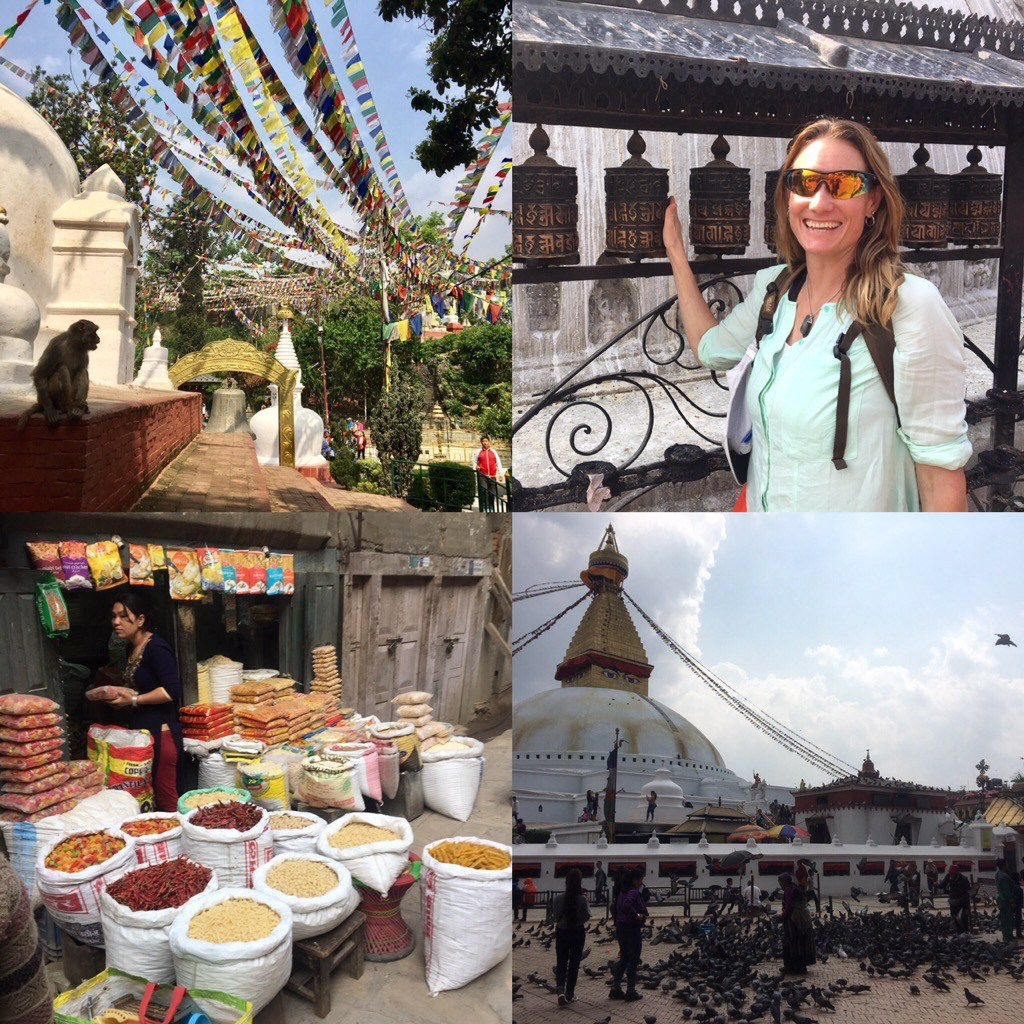
imageHello from Kathmandu, Nepal! We’ve been here for about 1.5 days, attempting to adjust our internal time clocks (Nepal is about 12 hours and 45 minutes ahead of PST), processing trekking permits, picking up supplies and doing some sightseeing. Photos will sync eventually through spotty, yet appreciated, wifi and I’ll share the album here (1st album just in now -https://photos.app.goo.gl/QymUFNBOASMM5lpY2) What a sight to see! Kathmandu is crowded, with narrow streets of open air markets, micro buses, motorcycles, bicycles and tuk tuks whizzing by on the opposite side of the road we westerners are used to. Watch out! And you thought traffic in the Bay Area was bad…

Tomorrow we fly to Lukla to begin our trek to Everest Base Camp. Because we’re leaving at 4 am ( it is now after midnight), I will try to keep this blog short but jump back in the next time I have access to wifi. For those of you interested in more commentary and reflective details of this journey, you can read on below the first few paragraphs. I’ll break up these posts in a way that those who want the high level report can read the “executive summary” and those who would like more of a novelistic read can choose to continue beyond that. Please also note that I am writing this blog with a mini iPad, so I may be “all thumbs” at times. Please excuse any typos.

Lukla is known as the most dangerous airport in the world due to its situation on a high altitude cliff. Check it out online – you’ll see what I mean. We’re flying a small plane and due to the extreme conditions, need to keep our weight down as much as possible. My duffel bag that will carry most of my gear to base camp and day pack must weigh no more than 15 kilograms (33 pounds). Considering I normally backpack for a long trip like this with at least about 50-60 pounds on my back, that’s not a lot of weight for the amount of snow gear I need to carry! I had to pare down my planned gear considerably.

Thankfully our food will be transported up the mountain and prepared for us. Sherpas will also carry our large duffel bags for us. Amazingly, they are able to strap several heavy bags to their backs or even over their heads. At times, yaks may carry some of our gear. God bless the Sherpas! (Side note; if you’d like to learn more about the Sherpa culture, I suggest reading the 2003 National Geographic issue that chronicles the 50 year anniversary of the first Everest summit.)

Our first day on trail from Lukla will lead us to Pakding, which is about 9,000 feet in elevation. We then travel to Namche, which is around 11,300 feet. Apparently the trail will be quite crowded with trekkers like me and climbers who will be summitting Everest. I’m sure we will hear many exciting stories along the away and I will try to capture footage of the plane ride and beginning trek to post to this blog the next time I have access to wifi.

Reflections on past couple days: Kathmandu is beautiful in so many inherent ways. The people are kind and gentle. The city is awash with brilliant colors of fabrics, jewelry, and fresh produce, spices and grains on display in open baskets and bamboo leaves aligning the streets. Blood red and gold temples and shrines fill the city. It is ritualistic for people to burn candles, incense, leave offerings, mark their faces with powders to symbolize their devout news, nod, kneel, pray and chant at these holy sites every day. The ornate carvings along cornices, doors and walls silently speak of the impeccable care and detail the Nepalese devote to their Hindu gods and rituals. While restoration efforts after the 2015 earthquake have been slow to say the least, the peoples’ care for these holy sites and their religious beliefs are evident in the painstaking way each piece of brick or shingle is handwashed, sanded, polished and laid back in its rightful place.

It’s been a great visit with the team mates I will be journeying with. We’ve had some delicious food with local Nepali friends of Gary’s – our fearless leader for this expedition – and were graciously toured around the market. It doesn’t get much better than a fresh, tree-ripened banana from a tuk tuk in the morning…unless you auspiciously pick a double banana in one peel! It must be good luck.

In Kathmandu, the holy sites, temples and stupas dominate the lifestyle and are all around (holy areas – I should know the difference in this terminology by the end of our trip). Hindus pilgrimage here to pray, touch the prayer wheels and leave offerings to the gods. For the record, I think the Sacred Monkey Temple (Bagmati) was my favorite. I was born in the year of the monkey on the Chinese zodiac, so I have a lighthearted affinity for the creatures. We’re known for being kind and honest, but with a bit of a troublemaking streak in us. Monkeys swing from branch to branch to get out of trouble. And they’re just so darn cute! But be careful; they can be mean! You’ll see evidence of this in the photo of a monkey trying to snatch my camera as I snapped a picture!

The stupa devoted to Shiva, the God of life, death and rebirth, is situated atop a hill above a river where the dead are cremated and scattered into the water. Families of the deceased come to pray and stay at this site for 13 days. Many other rituals accompany this period of grieving, which can last six months or longer. I took a photo of the “monkey god” here, as he looks only at Ram, another deity whose temple is located at this site.

Thanks to our fantastic guides, I learned a ton about the Hindu religion, beliefs, deities and rituals. It’s a fascinatingly complex religion that is deeply entrenched in their culture. I hope to share more on this later. For now, I’ll leave you with this chant – Om – which in the Hindu religion is the sound that was made when the universe was created. May all that life, love and energy fill all of us. Thank you for your prayers as we begin our journey up the tallest mountain in the world.

Namaste,

Cat

Preparations

How does one prepare to trek to the tallest mountain in the world? It takes mental grit and intense physical training to be able to hike to Everest base camp, and beyond, to Kala Pattar, at around 19,000 feet. This will be my blog for that journey, which I embark on tonight.

At 11:55 pm my plane leaves for Guangzhou, China, then I’m on to Kathmandu, Nepal. I will be trekking for three weeks to and from base camp, and afterward sojourning to Vietnam for about 10 days. Internet access will be spotty throughout this trip, so I will post here when possible.

Stay tuned if you’re interested, and I will share with you my photos, trek notes and journal entries. Much of this may be personal reflections, perhaps in the form of poetry or field notes. My hope is to share with you some of the cultural experiences along the way, including stories of the people I encounter, as well as description of the adventure, trail, and team I will be traveling with. Going in with eyes and mind wide open, ready for the adventure

Hope you enjoy the ride!

Cat